From what you tell it
Conversations, and the questions it asks when it isn’t sure.

The engine
Talia, Imprint and Atlas look different, but they run on the same thing: a picture of you that you own, the context you choose to connect to it, and the sense to bring the right piece back when it matters.
Outside in
It sees your files, your tasks and the chat in front of it, and guesses who you are from the pieces. Every time, a new guess.
Inside out
Start with how you think, how you work and what you’re aiming for. Everything else connects to that.
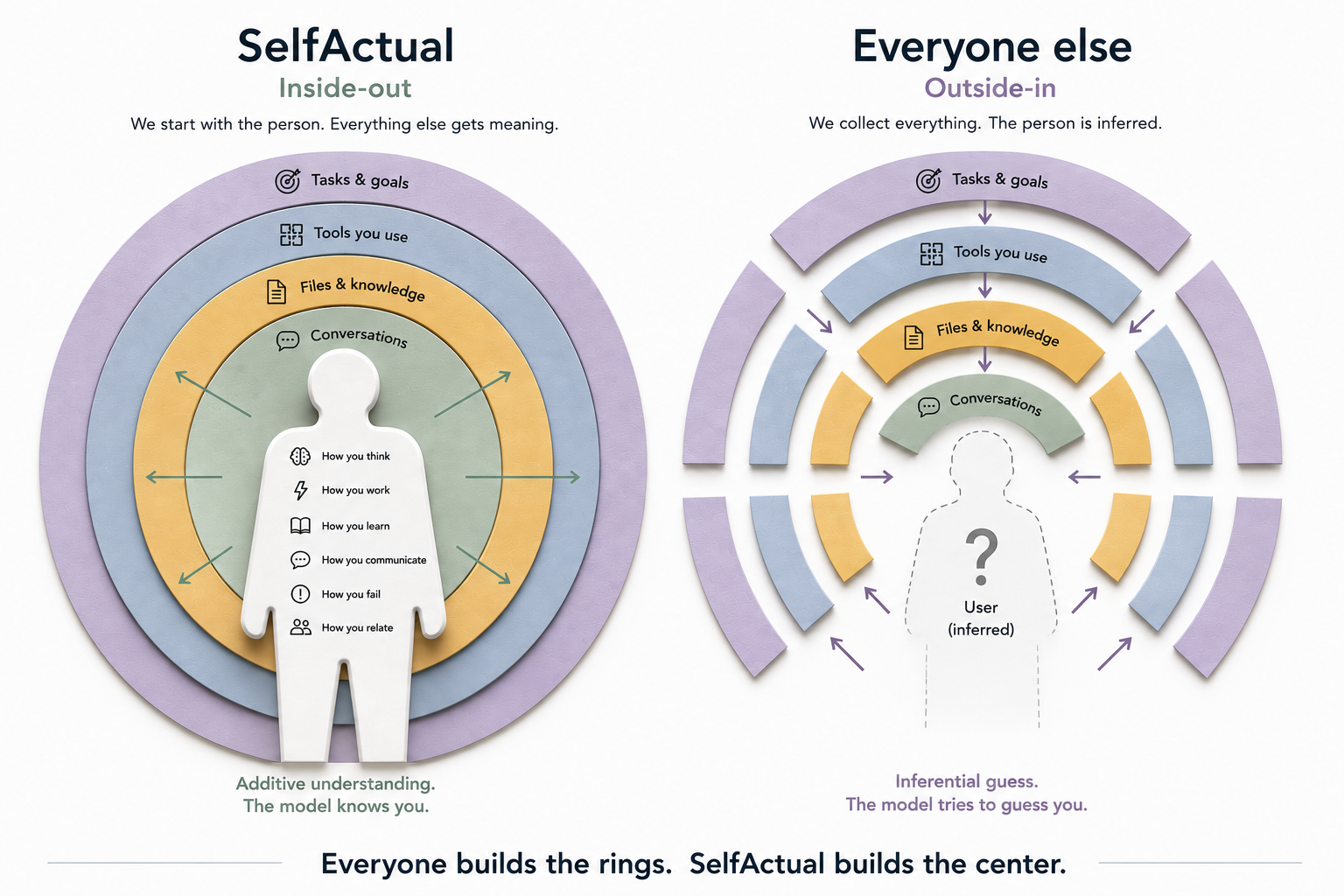
The center · Atlas
Atlas is the part of the engine that understands you: how you’re wired, what you’re aiming for, what gets in your way. It builds that picture slowly, from four places.More on Atlas →
Conversations, and the questions it asks when it isn’t sure.
What you start, what you put off, what you come back to. Only inside selfActual.
Assessments you’ve already taken, like MBTI, Enneagram or StrengthsFinder.
It asks whether a read sounds right. If you disagree, it drops it.
The rings · Your sources
There’s no fixed list. A parent’s context is a school app and a family calendar. A founder’s is a board deck and three half-finished conversations. The engine reads only what you connect, and you can turn any of it off. These are some common ones.
Assignments, due dates and grades from the LMS. Read-only.
Your schedule, and the family calendar if you share it.
Through Imprint, inside Claude, so you never start a chat from zero.
What you already know, so you don’t have to paste it in again.
Memory holds what you said. Continuity keeps up with what’s changed since: what’s due now, what you’re aiming for, what’s no longer true. And because the picture is yours, it comes with you from one product to the next.
We don’t sell your data — ever. We do count page views, to see which pages land. How that works, and how to turn it off.